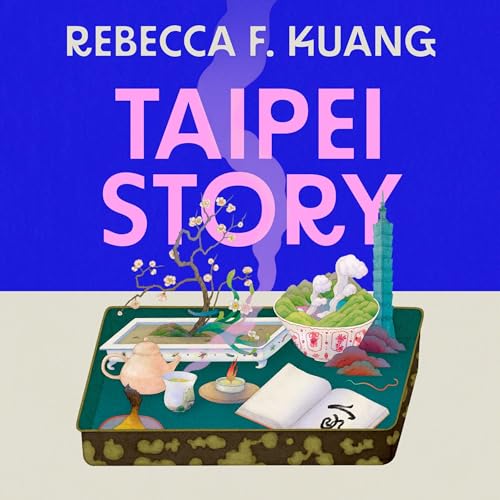
Taipei Story, by R. F. Kuang | Free Audiobook
What Lily Chen goes looking for in Taipei
Lily Chen signs up for an intensive Mandarin program in Taipei the summer after her first year of college, on the theory that a language is a door and she has been standing outside it her whole life. She grew up with the sound of Chinese in the house without ever being handed it. Six weeks of drills, she thinks, and the door opens.
Taipei has other plans. The classes are punishing in a way that makes her feel further from the language rather than closer, the city keeps reminding her she is a visitor here too, and an ill-judged trip to the hot springs turns into gossip she cannot walk away from in a program that small. Then, halfway through the summer, her grandfather dies at home, and every question she never got round to asking him goes with him.
This is R. F. Kuang's sixth novel and the first with no magic and no war anywhere in it. One summer, one young woman working out whether fluency was ever going to give her what she wanted from it, over the shortest ten hours she has ever asked of anyone. Kuang did the same program and lost her own grandfather during it, which is why this one reads closer to the bone than anything she has published.

This is the first Kuang that has split her audience straight down the middle, and the numbers say it plainly: 3.6 on Goodreads across a thousand early ratings, where Babel and Katabasis both sit well above four. Ten hours and twenty five minutes with Carolyn Kang, and none of the machinery people come to Kuang for. Whether that reads as a loss or a relief will decide how you get on with it.
What she has written instead is the closest thing to autobiography she has attempted. Kuang went through this exact program, and her own grandfather died while she was in Taipei. That origin shows in the only part of the book nobody argues about: the grief chapters. Reviewers who found the rest inert agree that these land, and they carry the emotional pressure the summer sections keep withholding. The other thing she gets right is the specific humiliation of the heritage speaker, close enough to the language to be expected to have it, far enough away to be caught out daily.
The objections are loud and they are consistent, so you should know them before you commit ten hours. Early reviewers say there is no plot to speak of and no tension driving the summer forward, that it plays as a study abroad diary. Lily takes the worst of it: several reviewers came away unable to say what she wants or how she has changed by the end. Long stretches on Taiwanese history, food and linguistics read to some like encyclopedia entries dropped into the narrative. And the ending stops rather than finishes, in a way that left more than one listener checking whether a file had failed to download.
So it depends almost entirely on who is listening. If you have ever sat in a room being addressed in a language your family speaks and you do not, this will find you where you live. If you came for the machinery of Babel or the nastiness of Yellowface, you will spend a lot of this waiting for something to happen that Kuang has decided is not the point. Ten hours is short for her, which cuts both ways: the thin patches pass quickly, and so does the whole thing.
Carolyn Kang has the harder job here than it looks. A first person interior monologue with no plot to lean on lives or dies on the performance, and the early listener response to her has been warm. Several people have said the audiobook is the right way into this one, which makes sense for a story built out of a voice talking itself through a bad summer. If you want the Kuang everyone else is talking about, Babel is the one that does the language argument at full scale with a plot underneath it, and Yellowface is her other contemporary novel, considerably meaner and much faster.
Taipei Story, by R. F. Kuang follows Lily Chen through one summer of intensive Mandarin classes in Taipei, taken in the belief that the language will hand her a version of herself she has been missing. The city does not cooperate, the classes go badly, and her grandfather dies at home partway through, taking the family history with him.
You can start it on a free trial, cancellable whenever you like. Narrated by Carolyn Kang and running 10 hours and 25 minutes, it is the shortest thing R. F. Kuang has written and the first with no fantasy in it at all.
Cancel the trial and Taipei Story stays yours. The trial opens the rest of the catalogue too, including Babel, Yellowface and the Poppy War books if this one sends you back through her work. Press play and go to Taipei for the summer.
Start your free trial, cancellable at any time
Some links on this page are affiliate links. As an Amazon Associate, I earn from qualifying purchases at no extra cost to you.

US-based editor & staff writer focused on audiobooks. Honest reviews, curated “best of” lists, and practical guides with an accessibility lens.
More Literature & Fiction Audiobooks