London Falling, by Patrick Radden Keefe | Free Audiobook
12 April 2026
Always (Rayne-Moore University), by Ruby Darling | Free Audiobook
12 April 2026Audiobook details
The most dog-eared book in office drawers since 1936
Dale Carnegie wrote this book in 1936, during the tail end of the Great Depression, after years of running courses on public speaking and human relations through the YMCA in New York. The material came from research into what actually determined whether people succeeded or failed in their professional and personal lives. The conclusion he arrived at was not about intelligence or technical expertise. It was about how people made others feel, and whether they had the skill to work with that rather than against it.
The book is organized around four areas. The first covers what Carnegie called the fundamental techniques in handling people, including the argument that criticism is almost always counterproductive, and that genuine appreciation unlocks more cooperation than pressure or authority. The second addresses how to make people like you, built on observations about what actually draws people toward someone rather than what people assume does. The third deals with moving people toward your own position without creating resistance. The fourth covers leadership, and specifically how to change behavior without generating resentment in the process.
More than 30 million copies have been sold since publication. The book has been in continuous print for nearly ninety years, translated into dozens of languages, and regularly appears on recommended reading lists across business, education, and self-help. Andrew MacMillan narrates the Simon & Schuster Audio edition across 7 hours and 3 minutes, working through the full text with a delivery suited to a book written to be read like a direct conversation rather than a lecture.

I had avoided this book for years because of the title. It sounded manipulative in the way that a lot of 1980s sales training sounds manipulative, and I assumed it would be full of techniques designed to make people do things without knowing why. It is not that book. It is almost the opposite of that book.
The opening section on criticism is the one I think about most often. Carnegie's argument is not that you should avoid difficult conversations. It is that pointing out what someone did wrong almost never produces the behavior change you want, because the person spends the conversation defending themselves rather than listening to you. He does not dress this up as a moral position. He treats it as a practical observation about how people work, and he backs it with enough examples that by the time he states the principle, you have already accepted it. That structure, the example first, the rule second, runs through most of the book and is part of why it reads so quickly.
The section on making people like you is where the advice risks feeling cynical, and Carnegie anticipates that reaction. He draws a clear line between performing interest in people and actually being interested in them. His point is that the techniques he is describing only function if they are genuine. Fake attentiveness produces exactly the result you would expect. The book is, in that sense, less about influence than about actually paying attention to the people around you, and using that attention to understand what they want before you ask them for anything.
The chapters on leadership are the ones I returned to after my first listen. Carnegie's argument is that you change behavior more effectively by pointing to what someone is already doing well than by cataloguing what they are doing badly. He cites enough specific cases, from Theodore Roosevelt to Charles Schwab to a series of anonymous managers in his courses, that the pattern starts to feel documented rather than asserted. Not every example has aged equally well. Some feel dated in their assumptions about workplace hierarchy. The underlying observation behind most of them has not.
Andrew MacMillan reads with a clarity and a measured pace that suits the material. Carnegie wrote in a conversational register, and MacMillan does not impose formality on it. At 7 hours and 3 minutes, the audiobook is short enough to finish across a few commutes and dense enough that most people find themselves going back to specific sections afterward.
Some links on this page are affiliate links. As an Amazon Associate, I earn from qualifying purchases at no extra cost to you.
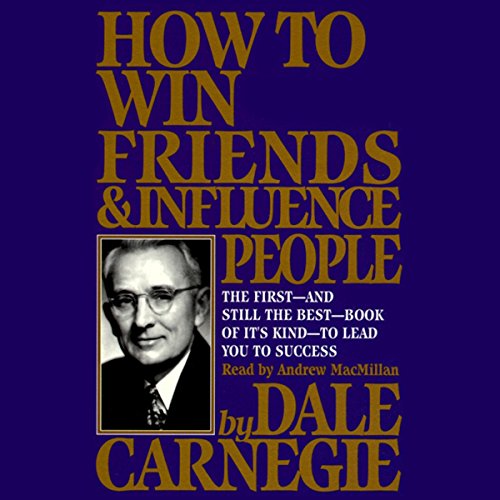
How to Win Friends & Influence People by Dale Carnegie was first published in 1936 and has sold more than 30 million copies across nearly nine decades of continuous print. Carnegie wrote it after years of teaching public speaking and human relations courses, drawing on what he observed about why some people built strong professional and personal connections while others, with equal intelligence and qualifications, consistently did not. The answer he arrived at had nothing to do with credentials.
Take advantage of the free trial, cancellable at any time, and hear Andrew MacMillan narrate all 7 hours and 3 minutes. MacMillan's pace is clear and direct throughout, which suits a book Carnegie designed to read like a conversation rather than a manual.
The audiobook remains yours forever, even after the trial ends. The free trial also gives you access to thousands of other titles at no ongoing cost. Start listening now.






More Military Fiction Audiobooks







US-based editor & staff writer focused on audiobooks. Honest reviews, curated “best of” lists, and practical guides with an accessibility lens.