
Kin, by Tayari Jones
5 March 2026
And Now, Back to You (Heartstrings, Book 2), by B.K. Borison
5 March 2026Audiobook details
The one question science keeps circling
There is one thing that scientists, philosophers, and poets have always agreed on, even when they agree on nothing else: it feels like something to be alive. That observation sounds obvious until you sit with it long enough and realize no one has ever explained it. A World Appears is Michael Pollan's attempt to find out why, and the journey takes him from neuroscience laboratories in Seattle to encounters with plant biologists, AI researchers, Buddhist monks, and eventually into a cave in the mountains of New Mexico.
Along the way, Pollan asks whether plants carry any flicker of sentience, whether feelings could be engineered into artificial systems, and what altered states of consciousness, including those he documented in How to Change Your Mind, actually reveal about the ordinary waking mind. Each discipline he visits turns out to have a piece of the answer, and none of them has the whole thing. That gap between the pieces is where the book lives.
What starts as a scientific investigation quietly becomes something more personal. By the end, the question has shifted: less about what consciousness is and more about how to inhabit it with more care. Named a most anticipated book of 2026 by The New York Times, TIME, and Oprah Daily, this audiobook is narrated by Pollan himself, which gives the material a reflective quality that suits the subject exactly.

I came to this audiobook already a reader of Pollan. How to Change Your Mind had reconfigured something in how I thought about the brain, and I was curious whether he could pull off the same thing with consciousness itself, which is a harder target. He can. And does.
The book opens with what philosophers call the hard problem of consciousness: not how the brain processes information, which neuroscience handles well enough, but why any of it is accompanied by a felt experience at all. Pollan frames it cleanly. He points out that even if you could map every neuron firing when someone sees the color red, you would still have no account of why there is something it is like to see red. That gap between the physical description and the subjective experience is what the whole book is built around, and Pollan is patient enough to let it stay unresolved rather than paper it over.
The middle section moves through plant neurobiology, AI research, literary fiction, and Buddhist practice, and Pollan handles each with the same skeptical curiosity. He is not trying to convince you that plants are conscious or that monks have solved something scientists haven't. He is genuinely asking what each discipline sees that the others miss. The plant neurobiologist chapter was the one that unsettled me most. Not because the argument is airtight, but because it forced me to recognize how narrow my assumptions about sentience were before I started listening.
The final section, set in a cave in New Mexico, is where the book earns its title. Pollan spends time in near-total darkness and silence as part of a deliberate practice, and what comes out of that experience is less a conclusion than a reorientation. He stops asking what consciousness is and starts asking what it would mean to live inside it more fully. It is a quiet ending to a book that could have gone for drama, and the restraint is exactly right.
On the narration: Pollan reads this himself, and at 8 hours and 46 minutes, the listening never drags. His voice carries the same measured curiosity as his prose. There is no performance in it, no attempt to make the science sound more exciting than it is. The result is intimate in a way that a professional narrator would not have achieved, because you are hearing a man think through a question he has not finished answering.
Some links on this page are affiliate links. As an Amazon Associate, I earn from qualifying purchases at no extra cost to you.
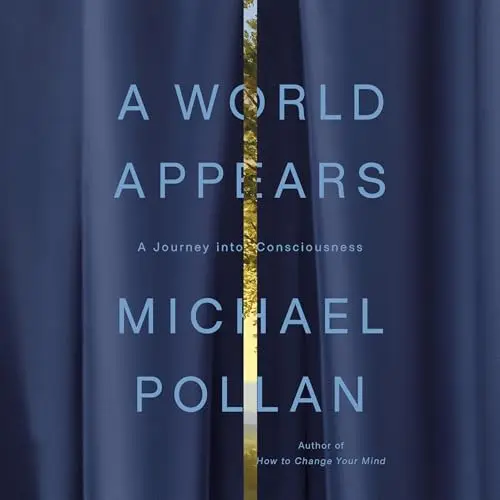
A World Appears by Michael Pollan is a nonfiction audiobook about consciousness: what it is, who has it, and whether modern science is any closer to answering that question than the philosophers who asked it first. Pollan, the author of How to Change Your Mind, visits neuroscience labs, plant biologists, AI researchers, and Buddhist practitioners, and reads the novelists who have spent centuries mapping subjective experience without calling it science. The audiobook runs 8 hours and 46 minutes and was released on February 24, 2026 by Penguin Random House Audio.
Take advantage of the free trial, cancellable at any time, and hear Michael Pollan narrate his own work. He recorded the audiobook himself, and the self-narration adds a layer of reflection that suits a book about the felt quality of being alive.
The audiobook remains yours to keep even after canceling the trial. The free trial also gives access to thousands of other titles, at no commitment and no risk. Start listening now.



More Self Development Audiobooks






US-based editor & staff writer focused on audiobooks. Honest reviews, curated “best of” lists, and practical guides with an accessibility lens.