
The Things We Never Say, by Elizabeth Strout | Free Audiobook
10 May 2026
The Fourth Option (Book 1), by Jack Carr and M.P. Woodward | Free Audiobook
17 May 2026Audiobook details
When kindness stops protecting society and starts destroying it
Gad Saad is a professor of marketing and evolutionary behavioral scientist at Concordia University in Montreal, and the author of The Parasitic Mind. In this follow-up, he turns to a specific mechanism he believes is accelerating the West's self-inflicted decline: the transformation of empathy from a biological asset into a political weapon. His argument is that empathy, unchecked by reason and consequence, does not simply fail to help, it actively inverts the moral order it claims to uphold.
The book examines concrete policy outcomes across criminal justice, immigration, gender ideology, and public safety, tracing each back to what Saad calls a systematic prioritization of the feelings of self-designated victim groups over verifiable facts. He draws on evolutionary psychology to explain why this pattern is not accidental but follows a predictable logic rooted in status signaling and coalition dynamics among educated elites.
Saad narrates the audiobook himself, as he did with The Parasitic Mind and The Saad Truth About Happiness. The result is six and a half hours of argument delivered in his own voice, which carries the same directness and controlled frustration that made his podcast audience grow into the millions. Listeners familiar with his work will recognize the style immediately. Those new to it will find the entry point clear and the position relentlessly documented.

I had read The Parasitic Mind before this, so I came in with a working sense of how Saad constructs an argument. Suicidal Empathy is denser and more focused. Where The Parasitic Mind mapped a broad landscape of ideological capture, this one drills into a single mechanism and follows it through a series of specific, named policy failures. The argument is tighter. The tone is angrier, but controlled.
The central thesis is that empathy, in the form it takes in contemporary progressive politics, functions as an anti-epistemology. It replaces the question "what is true?" with "whose suffering is most visible?" Saad backs this with examples from criminal sentencing, homelessness policy, drug harm reduction programs, and immigration enforcement, and in each case the structure of his critique is the same: the policy was designed to signal compassion, the measurable outcomes worsened the situation it was meant to address, and the people harmed most were those with no political voice. None of that is new as an observation. What Saad does that is less common is connect each example to an evolutionary framework explaining why this pattern is stable and self-reinforcing rather than simply the result of bad ideas held by well-meaning people.
There is a chapter on the relationship between victimhood status and social capital that I found genuinely illuminating. Saad is at his best when he slows down and works through the incentive structure rather than just cataloguing the damage. The book is more persuasive in those passages than in the ones where the register tips toward polemic. Both modes are present, and readers will calibrate differently depending on how much patience they have for the latter.
One thing this book does well that many in the same genre do not: Saad anticipates the strongest counterarguments and addresses them directly, including the criticism from Steven Pinker that received some attention before publication. He does not always resolve the tension cleanly, but he names it rather than pretending it does not exist. That is worth something.
Gad Saad narrates the audiobook himself, and it is the right call. His voice carries the intellectual urgency of the material in a way a professional narrator could not replicate. At 6 hours and 30 minutes, the pacing is well-managed. The delivery is conversational but precise, and the production from HarperCollins Audio is clean throughout. This is exactly the kind of book that benefits from the author's own voice on the recording.
Some links on this page are affiliate links. As an Amazon Associate, I earn from qualifying purchases at no extra cost to you.
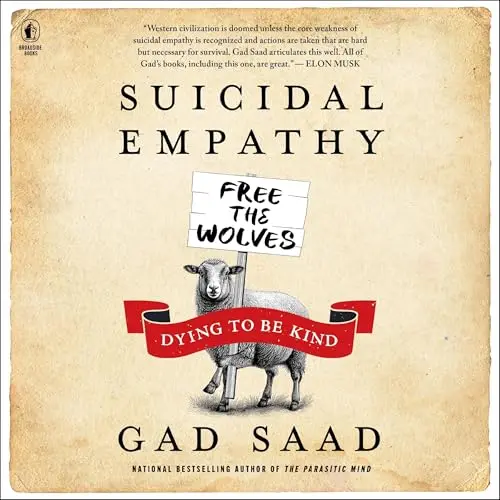
Suicidal Empathy: Dying to Be Kind is Gad Saad's third major work of cultural criticism, published by HarperCollins on May 12, 2026. Saad, a professor and evolutionary behavioral scientist, argues that a specific form of political empathy, one that systematically favors the loudest claim of victimhood over factual outcomes, is producing measurable harm across Western institutions. The book draws on his background in evolutionary psychology to explain why this pattern spreads and why it is resistant to correction through normal political debate.
Take advantage of the free trial, cancellable at any time, and hear Gad Saad deliver his own argument across 6 hours and 30 minutes of unabridged audio. He narrated this book himself, as he did with his previous titles, and the directness of his speaking voice gives the material a clarity that serves the argument well.
The audiobook remains yours forever, even after the trial ends. The free trial also gives you access to thousands of other titles, with no commitment. Start listening now.







More Politics Audiobooks







US-based editor & staff writer focused on audiobooks. Honest reviews, curated “best of” lists, and practical guides with an accessibility lens.