
Slough House – The Complete Audiobook Series
9 April 2026
Land of Wolves (Land of Wolves, Book 1), by Invi Wright | Free Audiobook
10 April 2026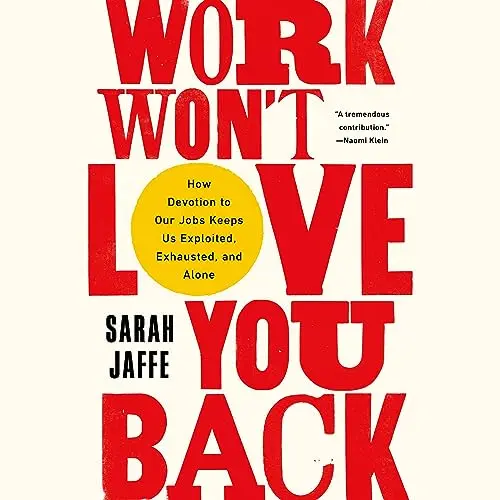
Audiobook details
Loving your job is not a virtue, it is a vulnerability
There is a phrase repeated so often it has become cultural furniture: do what you love and you'll never work a day in your life. Sarah Jaffe, who spent years covering labor and inequality for outlets including The New York Times and The Nation, looked closely at what that phrase actually produces. Work Won't Love You Back, published in January 2021, is her account of how an idea that sounds like encouragement functions, in practice, as a mechanism for paying people less and asking them to feel grateful for it.
Jaffe builds her case through sustained reporting on workers in specific industries: an unpaid intern trading wages for professional access, a teacher absorbing workload increases because leaving would feel like abandonment, a domestic worker expected to provide care as an extension of femininity rather than skill, and a professional athlete whose body is consumed by an industry that frames the opportunity itself as compensation. Each chapter covers a different sector. Each one arrives at a similar finding: the industries most likely to invoke love, vocation, and passion as motivation tend to be the ones least willing to pay workers what those efforts are worth.
Sarah Jaffe narrates the audiobook herself, and that choice is not incidental. The research behind this book came from years of interviews with workers who had rarely seen their situations examined from this angle, and her voice carries that closeness. She does not perform distance from the material. At 13 hours, the format suits the scope, and the chapters do not require you to already share her conclusions to find the evidence worth following.

I went into this one already half-convinced. I had read some of Jaffe's journalism and had a rough sense of where the argument was going. The book surprised me anyway, not because it arrived somewhere unexpected but because of how carefully it got there.
The book is organized by industry, and that structure is doing real work. Each chapter follows a different category of worker, and reading them in sequence makes the pattern difficult to dismiss as something specific to one sector. What links a nonprofit employee in their fourth year of deferred salary promises to a domestic worker told that providing care is a natural extension of feminine instinct? Jaffe's answer is consistent across every chapter: the same ideology, applied in different registers, extracts labor by making workers feel that asking for more would be a betrayal of who they are.
The chapter on teachers left the deepest impression. Jaffe traces how the vocation of teaching was shaped by decades of feminization, and how the expectation that good teachers give everything was used to rationalize wages that a male-dominated profession would not have tolerated for long. She is not making a simple argument about gender and pay. She is showing how the two became structurally linked in a way that persists well past the legal changes that were supposed to fix it. One teacher she interviews calculates her actual hourly compensation once evening grading and weekend planning are factored in. The number is not good.
The chapter on unpaid internships covers some familiar ground but anchors it in legal history and direct testimony. Jaffe traces how the intern economy developed employer protections that exist nowhere else in labor law, and she interviews people still carrying debt from the years they spent working for free in exchange for the experience of being in a room where decisions happened. The book's argument is patient and accumulative. It builds case by case, and by the later chapters, you are less likely to push back than to start counting the jobs you have had that fit the pattern.
Sarah Jaffe reads this herself. She moves quickly through her own analysis and slows on the interview excerpts, which creates a natural rhythm between her argument and the testimony of the workers she spent years talking to. There is no performance in it. At 13 hours, the length is earned.
Some links on this page are affiliate links. As an Amazon Associate, I earn from qualifying purchases at no extra cost to you.
Work Won't Love You Back by Sarah Jaffe opens with a premise that most of us have been handed without questioning: that doing what you love is its own reward. Jaffe spent years reporting on what that idea actually costs. Through teachers, domestic workers, tech industry employees, and professional athletes, the book traces how the language of passion and vocation has been used across industries to normalize conditions that workers in less romanticized sectors would not have accepted.
Take advantage of the free trial, cancellable at any time, and hear Sarah Jaffe narrate all 13 hours herself. She is a journalist reading her own reporting, and the difference is audible. Her pacing is direct and close, and she slows on the interview excerpts in a way that lets the testimony of the workers she spoke with stand apart from her analysis.
The audiobook remains yours forever, even after the trial ends. The free trial also gives you access to thousands of other titles at no ongoing cost. Start listening now.







More Labor Audiobooks







US-based editor & staff writer focused on audiobooks. Honest reviews, curated “best of” lists, and practical guides with an accessibility lens.