The Mistake (Off-Campus, Book 2), by Elle Kennedy | Free Audiobook
12 April 2026
Into the Blue, by Emma Brodie | Free Audiobook
12 April 2026Audiobook details
She sold the fantasy. Reality came to collect.
Natalie Heller Mills has 8 million Instagram followers who believe they are watching a woman live the life she preaches. She films sourdough in a farmhouse kitchen in Idaho, walks barefoot with her six children, and frames her marriage to Caleb, her cowboy husband, as a model of traditional partnership. What her audience does not see are the nannies, the producer who edits her content, and the modern appliances concealed behind renovated cabinetry. The performance is tight, relentless, and by any financial measure, extremely successful.
Then one morning Natalie wakes up in 1855, and the performance has been replaced by something worse. The farmhouse is real this time, without the cabinetry trick. The firewood is heavy. The laundry draws blood. The book runs two parallel timelines: the 1855 present, where Natalie tries to determine whether she has been transported, tricked, or broken, and the recent past, where her life as an influencer is documented with a precision that makes the gap between the Instagram version and the Idaho reality increasingly difficult to look away from.
Caro Claire Burke's debut novel, GMA's Book Club Pick for April 2026 and published by Knopf, is built around a narrator who cannot be fully trusted and knows it. The book works as a thriller because the question of what is actually happening to Natalie in 1855 stays open until late. It works as satire because the life she was living before was already a performance of the past, and the 1855 version simply removed the filter. Movie rights were acquired by Anne Hathaway following an eleven-way bidding war. Rebecca Lowman narrates across 13 hours and 47 minutes.

Natalie Heller Mills is a specific kind of awful that is very hard to look away from, and Caro Claire Burke clearly enjoyed writing her. The first thing you need to know about this audiobook is that it is frequently funny. The second is that the humor does not make what happens any less disturbing.
The double timeline works because neither half is allowed to be the comfortable one. The modern Instagram chapters should be the grounded side of the story, the familiar world to return to. Instead Burke writes the influencer life with enough specificity about its mechanics that it becomes just as disorienting as the 1855 material. The nannies Natalie barely acknowledges, the producer who shapes her content, the pesticides hidden among the zucchini, the sourdough starter maintained in a kitchen deliberately remodeled to conceal every appliance: the gap between what Natalie is selling and what she is actually doing accumulates into something that starts to feel genuinely sinister before the past timeline has done much more than set the scene.
The 1855 strand gives the book a way to pressure-test the ideology Natalie has been performing. She has built her brand around the idea that women were more purposeful, more rooted, better somehow, before modernity complicated everything. The actual experience of 1855 is labor without relief, cold without insulation, and a dependency on Caleb that unsettles her in ways the camera-ready version of their marriage never did. Burke does not belabor the irony. She simply presents the results of the test and trusts the reader to draw the conclusion.
The accounting that closes the book is not a twist so much as an itemized list. The charges Natalie ultimately faces, including wire fraud, improper working conditions, aggravated assault, animal abuse, and child abuse, among others, are presented with the same dry matter-of-fact tone the narrative uses throughout. Burke does not signal how you should feel. Natalie is monstrous in ways the book has been quietly documenting from the opening pages, and she is also a product of systems that wanted something specific from her, rewarded her for delivering it, and then watched.
Rebecca Lowman reads Natalie with a controlled composure on the surface that makes the moments of fracture audible in a way that flat delivery could not produce. She holds the distinction between the two timelines in her pacing without making the transition heavy-handed, and at 13 hours and 47 minutes, the audiobook does not drag. The two halves of the story have genuinely different textures in her hands.
Some links on this page are affiliate links. As an Amazon Associate, I earn from qualifying purchases at no extra cost to you.
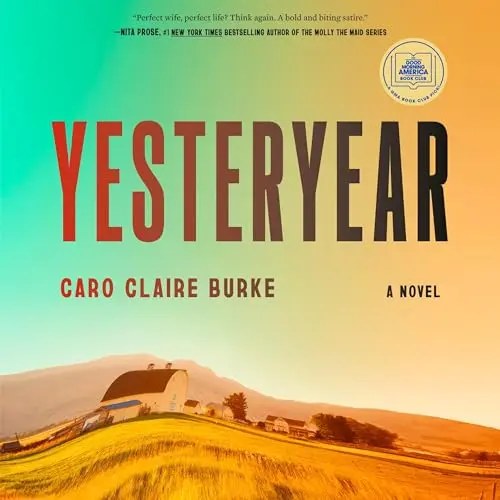
Yesteryear by Caro Claire Burke is GMA's Book Club Pick for April 2026 and Burke's debut novel, published April 7 by Knopf. It follows Natalie Heller Mills, a tradwife influencer with 8 million followers whose curated farmhouse life in Idaho, built on nannies and a producer her audience knows nothing about, is replaced overnight by the actual 1855 version of everything she has been selling. Burke describes the book as one part thriller, one part social commentary, and one part slapstick comedy. It is all three, sometimes in the same paragraph.
Take advantage of the free trial, cancellable at any time, and hear Rebecca Lowman narrate all 13 hours and 47 minutes. Lowman calibrates Natalie's voice with a surface composure that makes the moments of collapse land harder, and she sustains the distinction between the two narrative timelines without making the alternation feel mechanical.
The audiobook remains yours forever, even after the trial ends. The free trial also gives you access to thousands of other titles at no ongoing cost. Start listening now.





More Literature & Fiction Audiobooks




US-based editor & staff writer focused on audiobooks. Honest reviews, curated “best of” lists, and practical guides with an accessibility lens.